9 Essential Spanish Lessons Every American Student Needs to Know
spanish lessons for american students
Learning Spanish as an English speaker comes with a specific set of hurdles. You have to figure out why a table is feminine, why there are two different ways to say “to be,” and how to stop pronouncing every vowel like it has three different sounds. This guide breaks down the nine biggest roadblocks for American middle and high school students, offering language cheat codes and native tips to help you sound less like a tourist and more like a local.
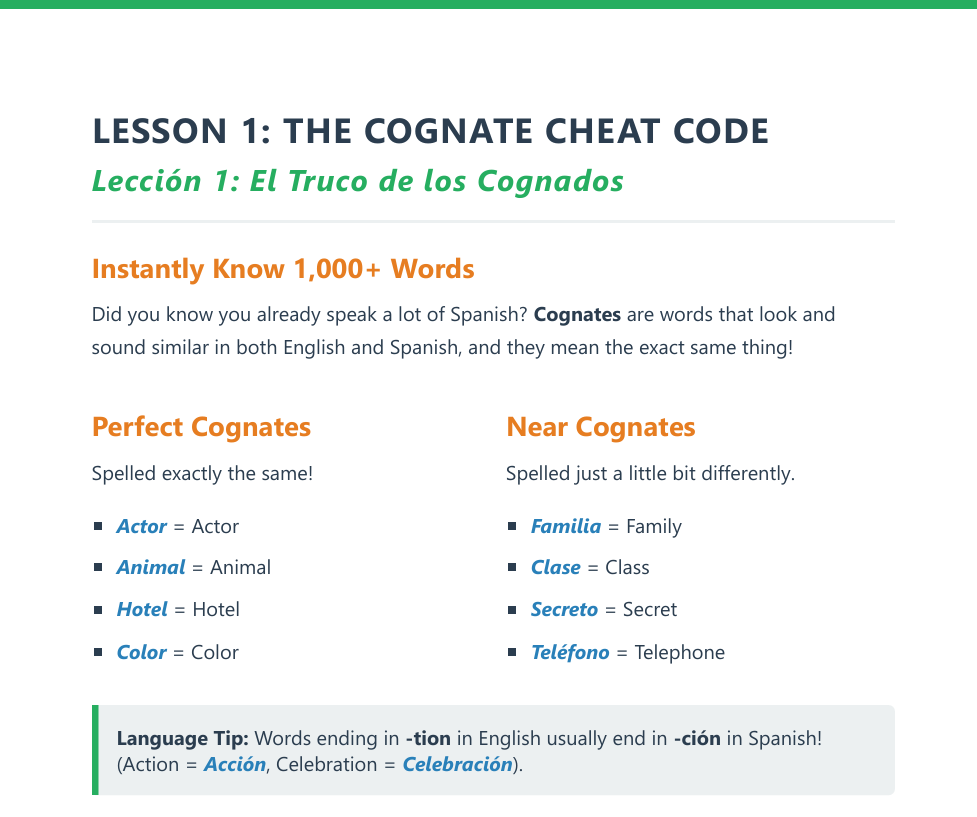
Lesson 1: The Cognate Cheat Code (El Truco de los Cognados)
You already speak a lot of Spanish without even realizing it. Cognates are words that look and sound similar in both English and Spanish, and they mean the exact same thing.
Perfect Cognates are spelled exactly the same. Examples include actor, animal, hotel, and color.
Near Cognates are spelled just a little bit differently. Examples include familia (family), clase (class), and teléfono (telephone).
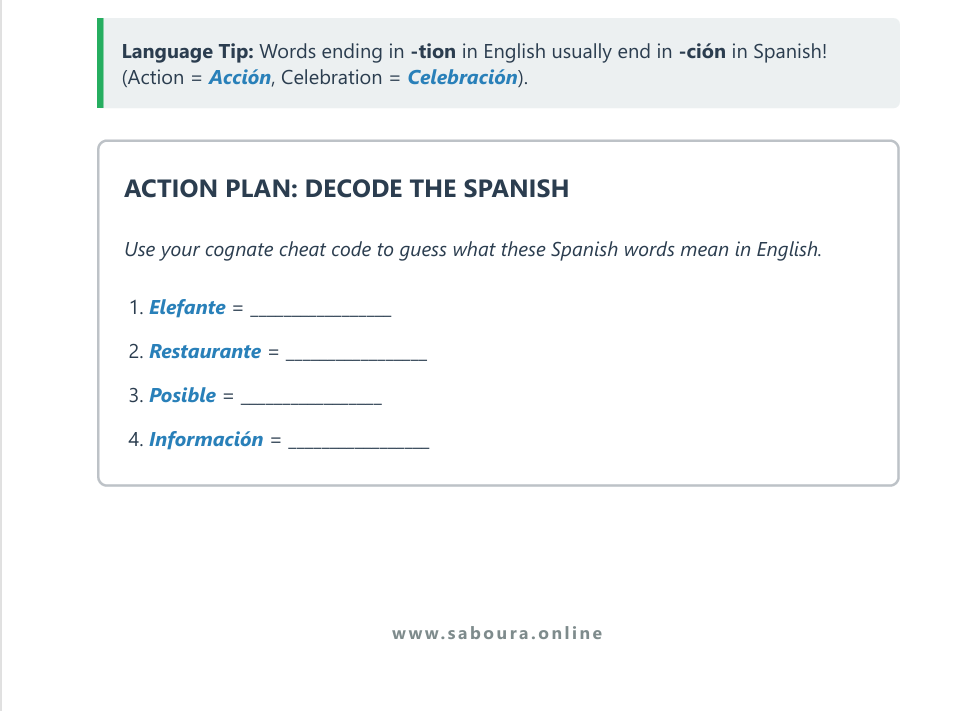
Language Tip: Words ending in -tion in English usually end in -ción in Spanish! For example, action becomes acción and celebration becomes celebración.
Lesson 2: False Friends (Falsos Amigos)
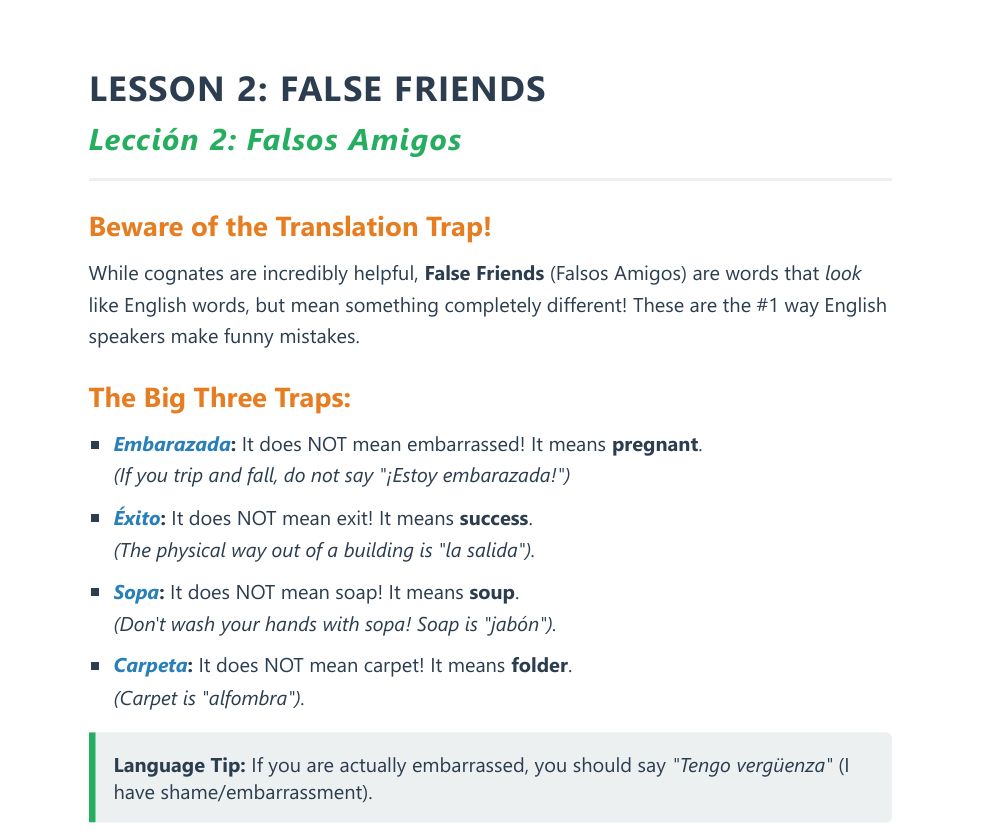
While cognates are incredibly helpful, false friends are words that look like English words but mean something completely different. These are the top traps for English speakers:
Embarazada: It does NOT mean embarrassed; it means pregnant. If you trip and fall, do not yell “¡Estoy embarazada!” If you are actually embarrassed, say “Tengo vergüenza” (I have shame).
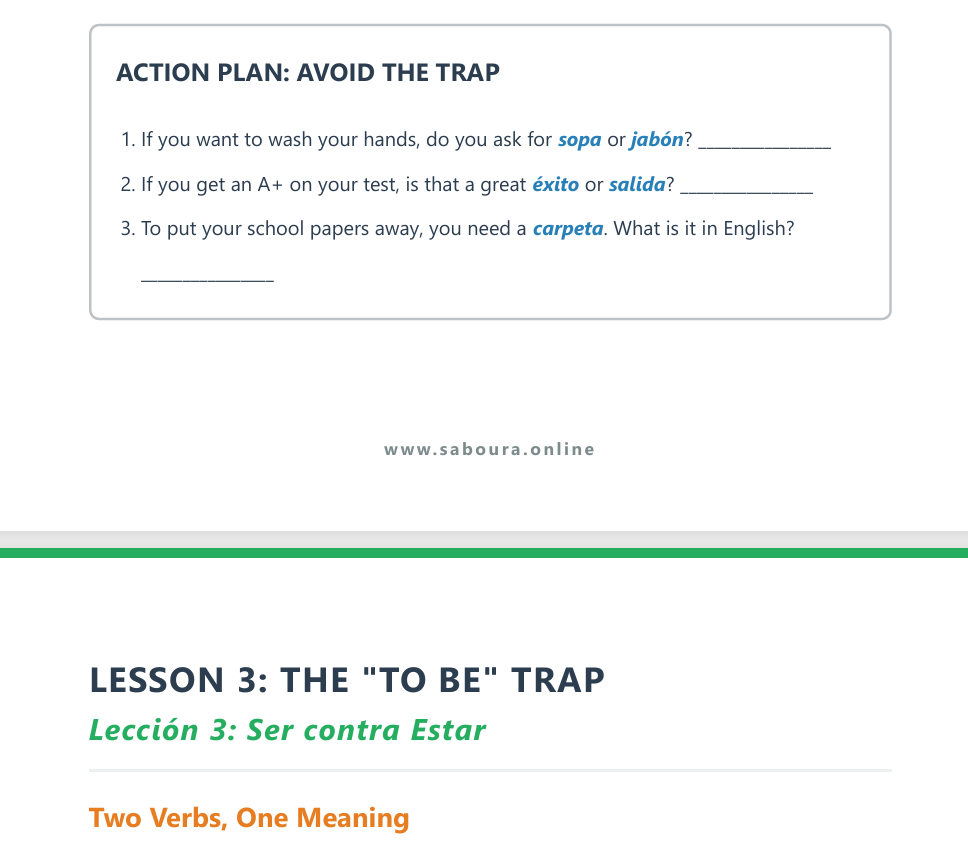
Éxito: It does NOT mean exit; it means success. The physical way out of a building is “la salida”.
Sopa: It does NOT mean soap; it means soup. Do not wash your hands with sopa. Soap is “jabón”.
Carpeta: It does NOT mean carpet; it means folder. Carpet is “alfombra”.
Lesson 3: The “To Be” Trap (Ser contra Estar)
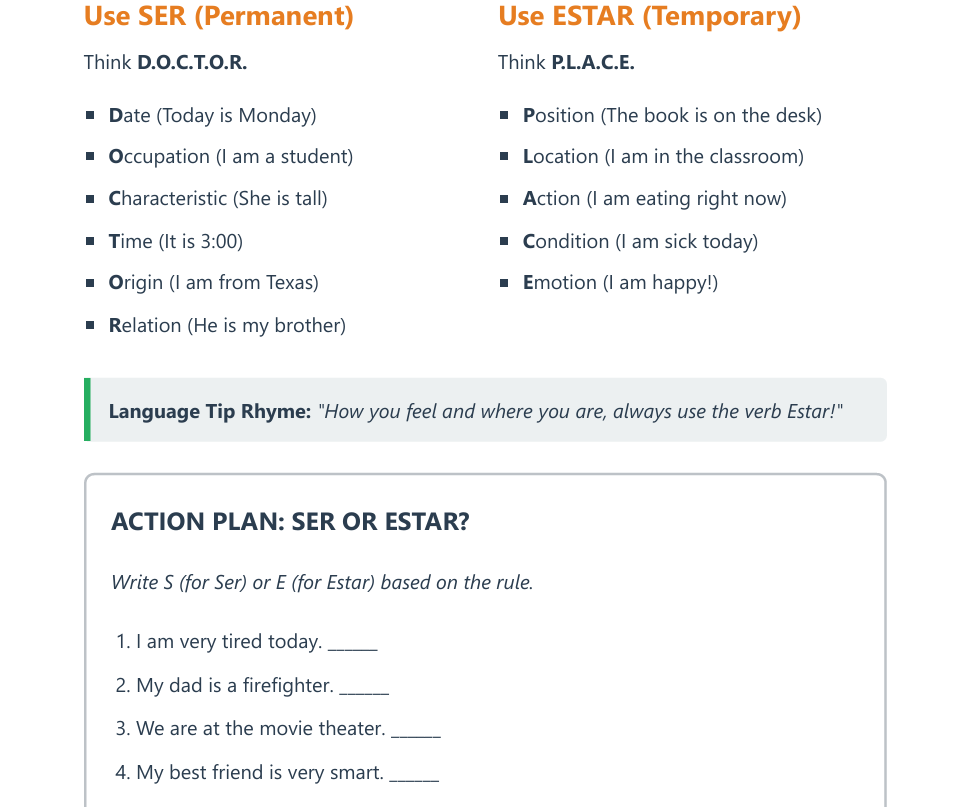
In English, we just use the verb “to be” (I am, you are, he is). In Spanish, there are two verbs: Ser and Estar. You have to choose the right one based on context. Remember this rhyme: “How you feel and where you are, always use the verb Estar!”
Use SER (Permanent) – Think D.O.C.T.O.R.
Date (Today is Monday)
Occupation (I am a student)
Characteristic (She is tall)
Time (It is 3:00)
Origin (I am from Texas)
Relation (He is my brother)
Use ESTAR (Temporary) – Think P.L.A.C.E.
Position (The book is on the desk)
Location (I am in the classroom)
Action (I am eating right now)
Condition (I am sick today)
Emotion (I am happy)
Lesson 4: Gender & Agreement (Género y Concordancia)
In English, a car is just a car. In Spanish, all nouns are either masculine or feminine. If the noun is masculine, the adjectives (describing words) have to be masculine too.
Masculine: Usually ends in -o. Uses el or los. Example: El perro negro (The black dog).
Feminine: Usually ends in -a. Uses la or las. Example: La casa blanca (The white house).
When dealing with plurals, everything gets an “s.” The article, the noun, and the adjective must all match. El chico alto (the tall boy) becomes los chicos altos (the tall boys). Furthermore, adjectives almost always come after the noun. You say “the car red,” not “the red car” (el carro rojo).
Lesson 5: Sounding Like a Native (Hablando como un Nativo)
To master pronunciation, you have to change how you say your vowels. English vowels have many sounds, but Spanish vowels have exactly one crisp sound each.
A – Sounds like “ah” (like opening your mouth for the doctor).
E – Sounds like “eh” (like the ‘e’ in “elephant”).
I – Sounds like “ee” (like the ‘e’ in “see”).
O – Sounds like “oh” (short and clipped).
U – Sounds like “oo” (like the ‘u’ in “flute”).
Watch out for tricky consonants: H is always silent (hola = “oh-la”), LL sounds like a Y (llama = “ya-ma”), and J sounds like a harsh H (jalapeño = “ha-la-pen-yo”).
spanish lessons for american students
Lesson 6: The Personal “A” (La “A” Personal)
This is a rule that exists in Spanish but does not exist in English. Whenever the object of your sentence (the thing receiving the action) is a person or a beloved pet, you must put an “a” before their name or title. It does not translate to anything in English; it is simply a grammatical sign of respect.
Looking at a thing (NO ‘a’): I see the book = Yo veo el libro.
Looking at a person (USE ‘a’): I see my brother = Yo veo a mi hermano.
spanish lessons for american students
Lesson 7: Native Idioms (Modismos Nativos)
Translating Spanish word-for-word sometimes sounds crazy because of idioms (modismos). These cultural phrases are used by native speakers all the time.
Tomar el pelo: Literally “to take the hair.” It means to pull someone’s leg or joke with them.
Estar en las nubes: Literally “to be in the clouds.” It means you are daydreaming or not paying attention.
Ser pan comido: Literally “to be eaten bread.” It means something is a piece of cake (very easy).
¡Qué padre! / ¡Qué chulo!: How cool! or Awesome!
spanish lessons for american students
Lesson 8: Por vs. Para (Por contra Para)
In English, we usually just use the word “for.” In Spanish, you must choose between Por and Para, and they are not interchangeable.
Think of PARA as an arrow hitting a target (destinations or goals):
Deadlines: The homework is for tomorrow.
Recipients: This gift is for you.
Destinations: We leave for Mexico.
Think of POR as motion, duration, or a scale balancing an exchange:
Travel (through/by): We walk through the park.
Exchange: I paid $10 for the pizza.
Duration: I slept for 8 hours.
spanish lessons for american students
Lesson 9: Accent Marks Matter! (¡Las Tildes Importan!)
Accent marks (las tildes) are not decorations. Putting a tiny line over a letter can completely change the meaning of the word.
Papa (potato) vs. Papá (Dad) — Don’t tell people you love your potato.
Si (if) vs. Sí (Yes) — Always accent ‘Sí’ when answering a question.
Tu (your) vs. Tú (You) — Tu perro (Your dog) vs. Tú eres (You are).
El (the) vs. Él (He) — El chico (The boy) vs. Él come (He eats).
Question words (¿Qué?, ¿Cómo?, ¿Dónde?) always require an accent mark. Additionally, Spanish uses an upside-down question mark (¿) at the beginning of a question to tell the reader to raise their voice before they even start reading the sentence.
Download the Spanish Lessons for American Students (PDF
Mastering these nine concepts will instantly elevate your Spanish from a struggling beginner to a confident, capable speaker ready to navigate real-world conversations. Keep practicing these core rules, and soon they will become second nature.
Grab your free, print-ready Spanish lesson guides right here. This complete packet covers everything from tricky false friends to mastering Ser vs. Estar, all perfectly formatted for middle and high school students. Hit the download button below to skip the translation traps and start sounding like a local today!
[ Download the Spanish Lessons for American Students (PDF) ]
9 Fun & Free Basic English Lessons for Kids (Printables!)
spanish lessons for american students